
The MINIX Book by Tanebaum & Woodhull
About the book
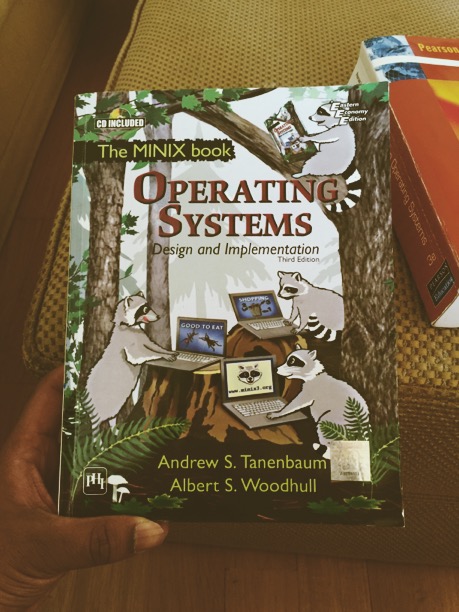
Operating Systems: Design and Implementation by Andrew S. Tanenbaum and Albert S. Woodhull, usually just called “the MINIX book”, is the companion to Tanenbaum’s Modern Operating Systems. Where that book explains OS theory, this one teaches by showing a complete, working operating system you can read line by line: MINIX, a small Unix-like system Tanenbaum wrote for teaching. The book walks through the real source code for processes, memory management, the file system and I/O, so the abstractions become concrete.
MINIX has a famous place in history: as a student, Linus Torvalds used it and was frustrated by its limits, which prompted him to write his own kernel, Linux, in 1991. MINIX itself went on to pioneer a microkernel design (keeping the kernel tiny and running drivers as ordinary, restartable processes for reliability), and MINIX 3 was later adopted, surprisingly, inside Intel’s Management Engine, making it for a while one of the most widely shipped operating systems in the world.
The section links below are chapters and topics I intend to write up in my own words as time allows.
Why it is worth reading
Reading about operating systems only takes you so far; reading a real one takes you the rest of the way. This book is the bridge between theory and the actual code that makes a computer manage itself, and it pairs naturally with Tanenbaum’s more theoretical volume.
- Processes
- Threads
- Interprocess Communication
- Scheduling
- Memory
- Virtual Memory
- Paging
- Segmentation
- File Systems
- I/O
- Clocks
- Deadlocks
- Encoding
- Compression
- Caching
- Virtualization
- Distributed Systems
- Security
- Cryptography
- Authentication
- Attacks
- Exploits
- Malware