
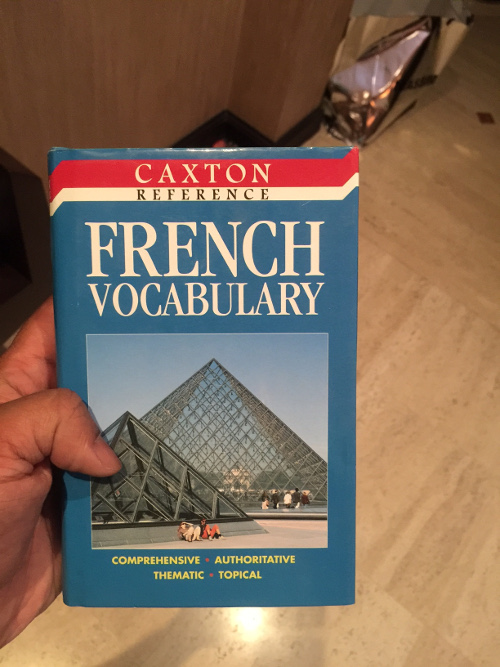
French Vocabulary
French | French Vocab 001 | How to Learn Languages | Vocab
The core idea in plain words
Every French noun has a gender — masculine or feminine — and you have to learn it together with the word. Not maison, but la maison. Not livre, but le livre. The gender changes the article, the adjectives and sometimes the pronoun, so a word learned without its article is only half learned.
This page is a themed starter list — the home and daily life — with the article attached to every noun. Learn them in the little phrase, out loud.
An analogy: name tags at a party
Think of every noun arriving at the party wearing a coloured name tag: blue for masculine (le / un), red for feminine (la / une). The tag doesn’t mean anything about the thing itself — a table isn’t feminine in any real sense — it just tells everyone else (articles, adjectives) how to talk to it. Learn the face and the tag at the same time, or you’ll be guessing all evening.
The article cheat sheet
| Masculine | Feminine | Before a vowel or mute h | Plural | |
|---|---|---|---|---|
| the | le | la | l’ | les |
| a / an | un | une | (un / une) | des |
| some | du | de la | de l’ | des |
For nouns starting with a vowel I give the indefinite article (un / une) too, because l’ hides the gender.
The list
La maison — the house
| French | Gender | English |
|---|---|---|
| la maison | f | house |
| l’appartement (un) | m | flat, apartment |
| la cuisine | f | kitchen; cooking |
| la chambre | f | bedroom |
| la salle de bains | f | bathroom |
| le salon | m | living room |
| le jardin | m | garden |
| la porte | f | door |
| la fenêtre | f | window |
| le mur | m | wall |
| l’escalier (un) | m | stairs |
| le toit | m | roof |
Les meubles — furniture
| French | Gender | English |
|---|---|---|
| la table | f | table |
| la chaise | f | chair |
| le lit | m | bed |
| le canapé | m | sofa |
| l’armoire (une) | f | wardrobe |
| le bureau | m | desk; office |
| la lampe | f | lamp |
| le miroir | m | mirror |
À la cuisine — in the kitchen
| French | Gender | English |
|---|---|---|
| le frigo / le réfrigérateur | m | fridge |
| le four | m | oven |
| l’assiette (une) | f | plate |
| le verre | m | glass |
| la tasse | f | cup |
| la fourchette | f | fork |
| le couteau (les couteaux) | m | knife |
| la cuillère | f | spoon |
| la casserole | f | saucepan |
| le pain | m | bread |
| l’eau (une) | f | water |
| le lait | m | milk |
| le fromage | m | cheese |
| la pomme | f | apple |
La journée — the day
| French | Gender | English |
|---|---|---|
| le matin | m | morning |
| l’après-midi (un) | m (or f) | afternoon |
| le soir | m | evening |
| la nuit | f | night |
| le petit-déjeuner | m | breakfast |
| le déjeuner | m | lunch |
| le dîner | m | dinner |
| le travail | m | work |
| la clé | f | key |
| le téléphone | m | phone |
| l’ordinateur (un) | m | computer |
Useful verbs (no gender, but you need them)
habiter (to live), manger (to eat), boire (to drink), dormir (to sleep), ouvrir (to open), fermer (to close), cuisiner (to cook), ranger (to tidy up), se lever (to get up), se coucher (to go to bed).
Gender clues (rules of thumb, not laws)
- Usually feminine: endings -tion, -sion (la nation), -té (la liberté), -ette (la fourchette), -ure (la voiture), -ence / -ance (la chance).
- Usually masculine: endings -ment (le bâtiment), -age (le fromage — but la page, la plage, **l’**image f), -eau (le couteau — but **l’**eau f, la peau), -isme, and most words ending in a consonant.
- Days, months, seasons, languages and metric units are masculine: le lundi, le français, le mètre.
A worked example: one noun, four changes
Take la fenêtre (window), feminine:
- La fenêtre est ouverte. — The window is open. (adjective takes -e)
- Ferme-la, s’il te plaît. — Close it, please. (pronoun la)
- Une grande fenêtre. — A big window. (grand → grande)
- Elle est cassée. — It’s broken. (elle, even though it’s a thing)
Now swap to le mur (wall), masculine: Le mur est blanc. Repeins-le. Un grand mur. Il est sale. Every word that touches the noun changes. That’s why the article must come attached.
Common misconceptions
- “Gender follows meaning.” La personne is feminine even for a man; le bébé is masculine even for a girl.
- “Words ending in -e are feminine.” Often, but le verre, le beurre, le musée, le lycée are masculine.
- “I’ll learn the genders later.” You won’t. Learn la clé, never clé.
- “Same spelling, same word.” Le livre = the book; la livre = the pound. Le tour = the tour; la tour = the tower.
Caxton Reference
Entries here follow the Caxton pocket-dictionary convention: short, with the article always given. For more words in context, see French and French Vocab 001; for method, How to Learn Languages and The Memory Chalet.