
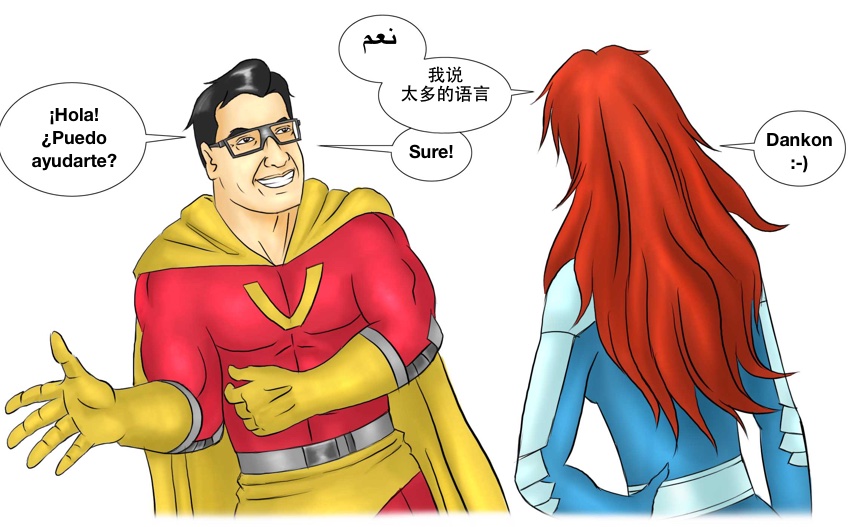
Arabic: Start Here
The plain idea
Arabic is a Semitic language, related to Hebrew and Aramaic, spoken as a first language by somewhere around 300–400 million people across the Middle East and North Africa, and the liturgical language of Islam for well over a billion more. It is written right to left in an alphabet of 28 letters, mostly consonants; short vowels are usually left unwritten and are supplied by the reader.
Two facts make Arabic different from most languages a learner meets:
- Diglossia. There is a formal written standard, Modern Standard Arabic (MSA, al-fuṣḥā), used in news, books and speeches, and a family of spoken dialects, Egyptian, Levantine, Gulf (including the Emirati Arabic I’m learning here), Iraqi, Maghrebi and more, used in daily life. They differ about as much as Italian, Spanish and Latin, and nobody speaks MSA at home.
- Roots and patterns. Most words are built from a root of three consonants carrying a core meaning, poured into vowel patterns.
Why it matters
Arabic is an official language in more than 20 countries and one of the six official languages of the United Nations. Historically it carried the science of the medieval world: the words algebra (al-jabr), algorithm (from the mathematician al-Khwarizmi), alchemy, zero and coffee all came into English through Arabic. And for anyone living in the Gulf, even a little Arabic transforms everyday encounters.
1. The alphabet and pronunciation
Arabic is written right to left in a joined-up script of 28 letters. Most letters have up to four shapes (alone, start, middle, end of a word), and short vowels are normally not written, only long ones (ا ā, و ū, ي ī).
| Letter | Name | Sound | Letter | Name | Sound |
|---|---|---|---|---|---|
| ا | alif | ā | ب | bāʾ | b |
| ت | tāʾ | t | ث | thāʾ | th (think) |
| ج | jīm | j | ح | ḥāʾ | breathy h |
| خ | khāʾ | kh (loch) | د | dāl | d |
| ذ | dhāl | dh (this) | ر | rāʾ | rolled r |
| ز | zāy | z | س | sīn | s |
| ش | shīn | sh | ص | ṣād | heavy s |
| ض | ḍād | heavy d | ط | ṭāʾ | heavy t |
| ظ | ẓāʾ | heavy dh | ع | ʿayn | throat squeeze |
| غ | ghayn | gargled gh | ف | fāʾ | f |
| ق | qāf | deep k | ك | kāf | k |
| ل | lām | l | م | mīm | m |
| ن | nūn | n | ه | hāʾ | h |
| و | wāw | w / ū | ي | yāʾ | y / ī |
Plus ء (hamza, the glottal stop) and ة (tāʾ marbūṭa, the feminine ending -a).
2. Core grammar
- The article is al- (ال), attached to the word: kitāb a book, al-kitāb the book. Before “sun letters” (t, d, r, s, sh, n…) the l assimilates: ash-shams (the sun), ar-rajul (the man).
- Gender: nouns are masculine or feminine; most feminines end in ة -a: mudarris (male teacher), mudarrisa (female teacher).
- No “is” in the present: al-bayt kabīr (البيت كبير), “the house (is) big”. anā min Dubay, “I (am) from Dubai”.
- Pronouns: anā I, anta / anti you (m/f), huwa he, hiya she, naḥnu we, antum you all, hum they.
- Possession with endings: kitābī my book, kitābak / kitābik your book (m/f), kitābuh his book.
- Roots and patterns (below) build most of the vocabulary.
3. Essential phrases (MSA, with Gulf variants)
| Arabic | Transliteration | English |
|---|---|---|
| السلام عليكم | as-salāmu ʿalaykum | Peace be upon you (hello) |
| وعليكم السلام | wa ʿalaykum as-salām | And upon you peace (reply) |
| مرحبا | marḥaba | Hello |
| كيف حالك؟ | kayfa ḥāluk? (Gulf: shlōnak?) | How are you? |
| بخير، الحمد لله | bikhayr, al-ḥamdu lillāh | Fine, thank God |
| اسمي … | ismī … | My name is … |
| شكرا | shukran | Thank you |
| عفوا | ʿafwan | You’re welcome; excuse me |
| من فضلك | min faḍlak | Please |
| نعم / لا | naʿam / lā (Gulf: ē / lā) | Yes / No |
| أريد … / ما أريد | urīd … (Gulf: abī …) | I want … |
| لا أفهم | lā afham | I don’t understand |
| مع السلامة | maThe digits explained one by one, with the letter charts from my old cards, are on Arabic: The Arabizi Alphabet. |
A worked example: one root, many words
Take the root k-t-b, which has to do with writing:
| Arabic | Pattern | Meaning |
|---|---|---|
| kataba | CaCaCa | he wrote |
| kitāb | CiCāC | book |
| kātib | CāCiC | writer |
| maktab | maCCaC | office, desk (place of writing) |
| maktaba | maCCaCa | library, bookshop |
| maktūb | maCCūC | written; also “fate” (what is written) |
Learn a root and a dozen patterns, and you can often guess words you’ve never seen. It’s a bit like Lego again: fixed bricks (the consonants), interchangeable connectors (the vowel patterns).
Arabizi: Arabic in Latin letters
When people began texting on phones without Arabic keyboards, they invented Arabizi (Arabic + Englizi), writing Arabic with Latin letters and using numbers for sounds English lacks, chosen because the digit looks like the Arabic letter. That is what my Arabizi page records:
| Number | Arabic letter | Sound |
|---|---|---|
| 2 | ء hamza | the glottal stop, the catch in “uh-oh” |
| 3 | ع ʿayn | a voiced squeeze deep in the throat |
| 3’ (or gh) | غ ghayn | a gargled “gh”, like a French r |
| 5 (or kh) | خ khāʾ | the “ch” of Scottish loch |
| 6 | ط ṭāʾ | an emphatic, heavy t |
| 6' | ظ ẓāʾ | an emphatic dh/z |
| 7 | ح ḥāʾ | a breathy h from the throat |
| 8 | ق qāf | a q pronounced far back |
| 9 | ص ṣād | an emphatic, heavy s |
So 3arabi is ʿarabī, “Arabic”, and ma3a salama is “goodbye”. Arabizi is informal, but it is everywhere in Gulf messaging, and it’s a great bridge while you learn the real script.
An everyday analogy: texting shorthand
Arabizi is the Arabic equivalent of writing “gr8” or “l8r” in English: a playful, practical hack born from keyboard limits that became a culture of its own.
Common misconceptions
- “Arabic is one language everyone speaks the same way.” The dialects differ substantially; a Moroccan and an Iraqi may switch to MSA or a neutral style to understand each other.
- “The script is impossibly hard.” Twenty-eight letters, most with up to four joined forms, can be learned in a few weeks of steady practice.
- “Arabizi is ‘wrong’ Arabic.” It’s a different spelling system for the same spoken language, not a different language.
How it connects
- Swahili: a Bantu language with many Arabic loanwords.
- How to Learn Languages
The digits explained one by one, with the letter charts from my old cards, are on Arabic: The Arabizi Alphabet.
The learning path
- Arabic: Start Here (you are here)
- Arabic: The Arabizi Alphabet