
Esperanto: Start Here
Practise: Esperanto flashcards and quizzes (works on any phone).
Core lists: vocabulary by theme · everyday phrases · example sentences
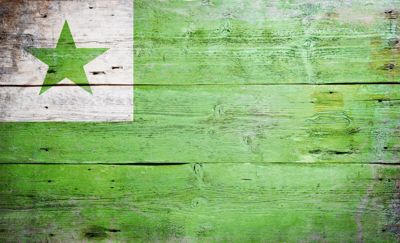
Esperanto is a wonderful language that I have been studying for a few years now. Like all language learning projects, it’s a little hard going, especially when no one around you speaks it and everyone thinks you’re crazy for even trying! However, I have fallen a little in love with the malgranda lingvo.
I am working (very sporadically) on a few projects in Esperanto. You can find my articles and translations below.
Esperanto estas mirinda lingvo, kiun mi studas de kelkaj jaroj. Kiel ĉiuj lingvolernaj projektoj, ĝi estas iomete malfacila, precipe kiam neniu ĉirkaŭ vi parolas ĝin kaj ĉiuj pensas, ke vi estas freneza, ke vi eĉ provas! Tamen mi iomete enamiĝis al la malgranda lingvo.
Mi laboras (tre sporade) pri kelkaj projektoj en Esperanto. Vi povas trovi miajn artikolojn kaj tradukojn sube.
Esperanto was published in 1887 by L. L. Zamenhof as an easy, neutral second language for everyone. Its grammar has no irregular verbs, and its words are built from roots with prefixes and suffixes, so a small vocabulary goes a long way.
1. Alphabet and pronunciation
28 letters, one sound each, and one letter = one sound always. Six letters carry a hat or a cup:
| Letter | Sound | Example |
|---|---|---|
| c | ts in “cats” | ci (you, familiar), centro |
| ĉ | ch in “church” | ĉokolado |
| ĝ | j in “jam” | ĝardeno garden |
| ĥ | ch in Scottish “loch” | ĥoro choir |
| j | y in “yes” | jes yes, jaro year |
| ĵ | s in “pleasure” | ĵurnalo newspaper |
| ŝ | sh in “ship” | ŝi she |
| ŭ | w (after a or e) | ankaŭ also, Eŭropo |
| aj, oj, ej, uj | eye, boy, hey, gooey | kaj and |
Stress is always on the second-to-last syllable: es-pe-RAN-to, fa-MI-li-o. If you can’t type the hats, the standard fallback is the x-system: cx, gx, hx, jx, sx, ux (cxokolado), but on this site I use the real letters.
2. Core grammar: the word endings
The ending tells you what kind of word it is:
| Ending | Meaning | Example |
|---|---|---|
| -o | noun | libro book |
| -a | adjective | bona good |
| -e | adverb | bone well |
| -j | plural | bonaj libroj good books |
| -n | direct object (accusative) | Mi legas bonan libron. I read a good book. |
| -i | infinitive | legi to read |
| -as / -is / -os | present / past / future | legas, legis, legos reads, read, will read |
| -us | conditional | legus would read |
| -u | command, wish | Legu! Read! |
Verbs never change for the person: mi legas, vi legas, ŝi legas, ni legas, ili legas.
Pronouns: mi (I), vi (you), li (he), ŝi (she), ĝi (it), ni (we), ili (they), oni (one). Add -a for “my, your…”: mia, via, lia, ŝia, nia, ilia.
Questions: put ĉu in front of a yes/no question: Ĉu vi parolas Esperanton? Do you speak Esperanto? Question words start with ki-: kio (what), kiu (who), kie (where), kiam (when), kiel (how), kial (why).
Negation: ne before the word: Mi ne komprenas. I don’t understand.
Building words like Lego
| Affix | Meaning | Example |
|---|---|---|
| mal- | opposite | bona good → malbona bad |
| -in- | female | frato brother → fratino sister |
| ge- | both sexes together | gefratoj brothers and sisters |
| -ej- | place | lerni learn → lernejo school |
| -ist- | profession | instrui teach → instruisto teacher |
| -uj- | container | guf- → gufujo chill-out room |
| -et- / -eg- | small / big | domo → dometo cottage, domego mansion |
3. Essential phrases
| Esperanto | English |
|---|---|
| Saluton! | Hello! |
| Bonan tagon / matenon / vesperon! | Good day / morning / evening! |
| Kiel vi fartas? – Mi fartas bone, dankon. | How are you? – I’m fine, thanks. |
| Mia nomo estas VikiD. / Mi estas VikiD. | My name is VikiD. |
| Ĝojas min renkonti vin. | Pleased to meet you. |
| Bonvolu … / Dankon! / Ne dankinde. | Please … / Thanks! / You’re welcome. |
| Pardonu. | Sorry, excuse me. |
| Mi ne komprenas. Bonvolu paroli malrapide. | I don’t understand. Please speak slowly. |
| Kiel oni diras … en Esperanto? | How do you say … in Esperanto? |
| Ĝis revido! / Ĝis! | Goodbye! / Bye! |
4. Vocabulary
- Esperanto: Vocabulary: my word cards in one place.
- Esperanto: Words I Am Learning: my big running word list.
The learning path
Lessons first, then my own scripts, then reading from easy to hard.
- Esperanto: Start Here (you are here)
- Esperanto: Notes from Learn.Esperanto.com
- Esperanto: Universala Esperanto-Metodo
- Esperanto: Universala Esperanto-Metodo, Unua Parto
- Esperanto: Bonvenon (Laŭra kaj Petro Malkovras Esperanton)
- Esperanto: Scripts and Phrases
- Esperanto: Mornings
- Esperanto: Spiritual Wake Up
- Esperanto: Quotes (Citiloj)
- Esperanto: Vocabulary
- Esperanto: Words I Am Learning
- Esperanto: Artikoloj (Articles)
- Esperanto: Suno
- Esperanto: Tertremo
- Esperanto: Egiptio
- Esperanto: Insulo de la Rozoj
- Esperanto: Maldolĉa Ĉokolado
- Esperanto: Trompo-Provoj per Esperanto
- Esperanto: Legaĵo (Reading)
- Esperanto: Everyday Phrases
- Esperanto: Dao De Jing
- Esperanto: Example Sentences
- Esperanto: La Sankta Biblio
- Esperanto: La Verda Biblio (1935, Izrael Lejzerowicz)
- Esperanto: Sidarto by Hermann Hesse
- Esperanto: La Unua Intervjuo
- Esperanto: La Kvara Intervjuo (Katalin Kovats)
- Esperanto: PicoLisp Installation
Links
- Plena Ilustrita Vortaro
- Lernu: a great site to get you started
- Learn Esperanto
- Esenco kaj Estonteco de la Ideo de Lingvo Internacia, by Dr L. L. Zamenhof, written by the creator of Esperanto
- Vikipedio · Partio (politiko) · Esperanto-kulturo
- Rules of Esperanto: Grammar Rules by Wikiversity, Grammar Rules by Don Harlow
- La Sankta Biblio website
- Literaturo Esperanto
- UEA Facila
- Mac keyboard for Esperanto
- Bertilow
- Bildvortaro
- Text-to-speech