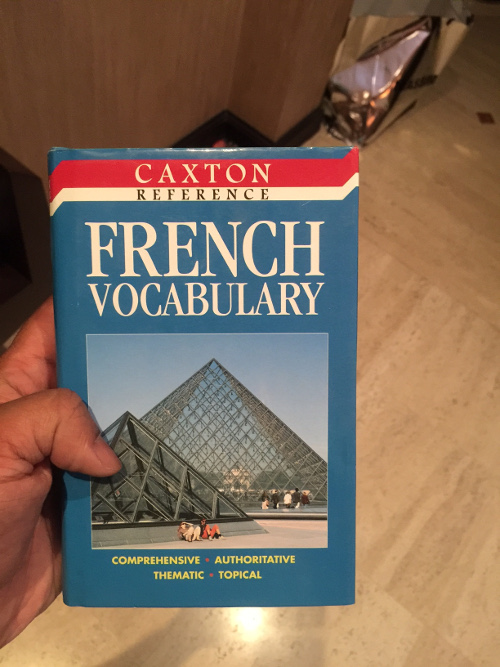
Every French noun has a gender — masculine or feminine — and you have to learn it together with the word. Not maison, but la maison. Not livre, but le livre. The gender changes the article, the adjectives and sometimes the pronoun, so a word learned without its article is only half learned.
This page has two parts: a themed starter list for the home and daily life, and the words I collected while reading (my old Vocab List 1 cards), each with its gender, meaning and an example sentence. The article is attached to every noun. Learn them in the little phrase, out loud.
An analogy: name tags at a party
Think of every noun arriving at the party wearing a coloured name tag: blue for masculine (le / un), red for feminine (la / une). The tag doesn’t mean anything about the thing itself — a table isn’t feminine in any real sense — it just tells everyone else (articles, adjectives) how to talk to it. Learn the face and the tag at the same time, or you’ll be guessing all evening.
The article cheat sheet
Masculine
Feminine
Before a vowel or mute h
Plural
the
le
la
l’
les
a / an
un
une
(un / une)
des
some
du
de la
de l’
des
For nouns starting with a vowel I give the indefinite article (un / une) too, because l’ hides the gender.
The list
La maison — the house
French
Gender
English
la maison
f
house
l’appartement (un)
m
flat, apartment
la cuisine
f
kitchen; cooking
la chambre
f
bedroom
la salle de bains
f
bathroom
le salon
m
living room
le jardin
m
garden
la porte
f
door
la fenêtre
f
window
le mur
m
wall
l’escalier (un)
m
stairs
le toit
m
roof
Les meubles — furniture
French
Gender
English
la table
f
table
la chaise
f
chair
le lit
m
bed
le canapé
m
sofa
l’armoire (une)
f
wardrobe
le bureau
m
desk; office
la lampe
f
lamp
le miroir
m
mirror
À la cuisine — in the kitchen
French
Gender
English
le frigo / le réfrigérateur
m
fridge
le four
m
oven
l’assiette (une)
f
plate
le verre
m
glass
la tasse
f
cup
la fourchette
f
fork
le couteau (les couteaux)
m
knife
la cuillère
f
spoon
la casserole
f
saucepan
le pain
m
bread
l’eau (une)
f
water
le lait
m
milk
le fromage
m
cheese
la pomme
f
apple
La journée — the day
French
Gender
English
le matin
m
morning
l’après-midi (un)
m (or f)
afternoon
le soir
m
evening
la nuit
f
night
le petit-déjeuner
m
breakfast
le déjeuner
m
lunch
le dîner
m
dinner
le travail
m
work
la clé
f
key
le téléphone
m
phone
l’ordinateur (un)
m
computer
Useful verbs (no gender, but you need them)
habiter (to live), manger (to eat), boire (to drink), dormir (to sleep), ouvrir (to open), fermer (to close), cuisiner (to cook), ranger (to tidy up), se lever (to get up), se coucher (to go to bed).
Gender clues (rules of thumb, not laws)
Usually feminine: endings -tion, -sion (la nation), -té (la liberté), -ette (la fourchette), -ure (la voiture), -ence / -ance (la chance).
Usually masculine: endings -ment (le bâtiment), -age (le fromage — but la page, la plage, **l’**image f), -eau (le couteau — but **l’**eau f, la peau), -isme, and most words ending in a consonant.
Days, months, seasons, languages and metric units are masculine: le lundi, le français, le mètre.
A worked example: one noun, four changes
Take la fenêtre (window), feminine:
La fenêtre est ouverte. — The window is open. (adjective takes -e)
Ferme-la, s’il te plaît. — Close it, please. (pronoun la)
Une grande fenêtre. — A big window. (grand → grande)
Elle est cassée. — It’s broken. (elle, even though it’s a thing)
Now swap to le mur (wall), masculine: Le mur est blanc. Repeins-le. Un grand mur. Il est sale. Every word that touches the noun changes. That’s why the article must come attached.
Common misconceptions
“Gender follows meaning.”La personne is feminine even for a man; le bébé is masculine even for a girl.
“Words ending in -e are feminine.” Often, but le verre, le beurre, le musée, le lycée are masculine.
“I’ll learn the genders later.” You won’t. Learn la clé, never clé.
“Same spelling, same word.”Le livre = the book; la livre = the pound. Le tour = the tour; la tour = the tower.
Words from my reading (Vocab List 1)
These came from texts and stories I was reading; each one was a separate card copied from WordReference. They are now condensed to the meanings that matter, with one example each.
Animals and nature
French
Gender
English
Example
la harde
f
herd (of wild animals); pack
Une harde de sangliers traverse la route. A herd of wild boar is crossing the road.
le renne
m
reindeer
Les rennes femelles portent aussi des bois. Female reindeer also have antlers.
le sabot
m
hoof; clog; wheel clamp
Il est important d’entretenir les sabots des chevaux. It’s important to look after horses’ hooves.
le croc
m
fang; hook
Ce chien a des crocs très aiguisés. This dog has very sharp fangs.
la fourrure
f
fur; fur coat
La fourrure du vison sert à faire des manteaux. Mink fur is used to make coats.
la pierre
f
stone, rock
Le diamant est une pierre précieuse. A diamond is a precious stone.
le paresseux
m
sloth (the animal)
Le paresseux grimpe au palétuvier. The sloth climbs the mangrove tree.
Describing people
Adjectives are given masculine / feminine.
French
English
Example
châtain / châtain(e)
chestnut-brown (hair)
Sa chevelure châtain est magnifique. Her chestnut hair is magnificent. (châtaine is also accepted)
paresseux / paresseuse
lazy
Cette élève paresseuse néglige ses devoirs. This lazy pupil neglects her homework.
capricieux / capricieuse
temperamental, capricious
C’est une enfant capricieuse. She is a temperamental child.
orgueilleux / orgueilleuse
proud, arrogant
Il est trop orgueilleux pour reconnaître ses erreurs. He is too proud to admit his mistakes.
épais / épaisse
thick
J’aime les tranches de jambon épaisses. I love thick slices of ham.
Things and feelings
French
Gender
English
Example
l’abat-jour (un)
m
lampshade
L’abat-jour de cette lampe tamise trop la lumière. This lamp’s shade dims the light too much. (plural les abat-jour, or abat-jours since the 1990 spelling reform)
la récompense
f
reward
La police offre une récompense de 50 000 $. The police are offering a $50,000 reward.
le souci
m
worry; (also) marigold
Le souci du lendemain gâche le plaisir de l’instant présent. Worry about tomorrow spoils the pleasure of the present.
la boucle
f
curl; loop; buckle
des boucles d’oreilles, earrings; une boucle de ceinture, a belt buckle
Verbs
French
English
Example
boucler
to curl; to buckle; to close off; to wrap up; (computing) to loop
Ses cheveux bouclent naturellement. Her hair is naturally curly. Ce programme boucle indéfiniment. This program loops forever.
brocher
to bind (a paperback); to brocade
Cette ouvrière broche les livres à la main. This worker binds the books by hand.
entremêler
to intermingle, mix
Les dates s’entremêlent dans ma tête. The dates are getting mixed up in my head.
foncer (fonçant)
to darken; to rush, charge
Sa peau a foncé avec le soleil. Her skin has darkened in the sun. Il fonce vers la sortie. He rushes towards the exit.
grimper
to climb
Mon chat grimpe souvent aux arbres. En primaire, j’ai appris à grimper à la corde. My cat often climbs trees. At primary school I learned to climb the rope.
servir (il sert)
to serve; to be used for
Puis-je vous servir un peu de vin ? May I pour you some wine? À quoi ça sert ? What is it for?
s’entraider
to help each other
Les voisins s’entraident. The neighbours help one another.