
Abstract Algebra | ZF Axioms | Math Set Theory | Number Theory | Groups | Quotient Groups | Rings | Commutative Rings | Fields | Group Actions | Modules | Vector Spaces | Linear Operators and Matrices | Inner Product Spaces | Tensors | Exterior Algebras | Theory | Polynomial Rings | Category Theory |
Abstract Algebra
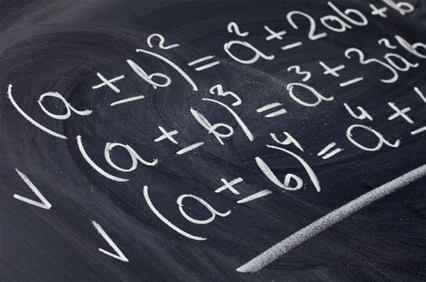
To me, Algebra is a branch of Mathematics that deals with symbols and the rules for manipulating those symbols. It really is the foundation of all Mathematics because it sets up and sets out the written language of math. Without algebra we would have no powerful method of communicating our Mathematical ideas (to humans or computers) and progress would essentially ground to a halt.
The plain idea
School algebra is about solving for . Abstract algebra asks a bolder question: what are the rules of the game itself? Instead of working with particular numbers, it studies operations (ways of combining things) and the laws they obey: is order important, is there a “do nothing” element, can every move be undone? Any system that obeys a given list of laws gets a name, a group, a ring, a field, and every theorem about that name applies to every system that wears it.
Why it matters
It is the great economy of modern mathematics. Prove something once about groups and you have proved it for clock arithmetic, for the symmetries of a crystal, for Rubik’s cubes and for the particles of the Standard Model. Abstract algebra also explains why things are impossible: why there is no general formula for degree-five equations (Galois), why you can’t trisect an angle with ruler and compass, and why some codes can correct errors and others can’t. Today it is the working language of cryptography, coding theory, quantum physics and computer graphics.
An everyday analogy: board games
Chess and draughts use the same board, but different rules make them different games. Abstract algebra is like studying games by their rules alone. Two games with identical rules are, for all practical purposes, the same game, whatever the pieces look like. Mathematicians call that being isomorphic.
A worked example: one law, two worlds
Take the rule “every element has an inverse”. Under ordinary addition of integers it holds: the inverse of is . Under multiplication of integers it fails: nothing whole times gives . Allow fractions (the rationals without ) and it holds again: the inverse of is . So the same set-like stuff can be a group under one operation and not under another, and enlarging the set can repair a broken law. That is the whole history of number systems (negatives, fractions, complex numbers) seen through algebraic eyes: each new kind of number was invented to give some operation its missing inverses.
The ladder of structures
graph TD
  S[Set: just elements] --> G["Group: one operation, inverses"]
  G --> R["Ring: + and ×"]
  R --> CR[Commutative ring]
  CR --> F["Field: you can divide"]
  F --> V[Vector space over a field]
  R --> M[Module over a ring]
  V --> T[Tensors and exterior algebras]
Each step adds a law or an operation. Below, the main stops on the ladder, each with a link to its own page.
Set Theory
The raw material. A set is a collection defined by its members and nothing else; everything below is a set with rules attached.
Number Theory
The integers and primes, the oldest source of algebraic structure. Arithmetic modulo is where groups and rings first become concrete.
Groups
One operation, with closure, associativity, an identity and inverses. The mathematics of doing and undoing, and the language of symmetry.
Quotient Groups
Squash a group by declaring some elements “the same” (a normal subgroup) and you get a smaller group. Clock arithmetic is the integers with multiples of 12 squashed to zero: .
Rings
Two operations, addition and multiplication, linked by the distributive law . The integers and the matrices are rings.
Commutative Rings
Rings where . Integers and polynomials are commutative; matrices are not. Most of number theory and algebraic geometry lives here.
Fields
Commutative rings where every non-zero element can be divided by: the rationals, the reals, the complex numbers, and the finite fields that power cryptography.
Group Actions
A group doing something to another object, like the rotations of a square moving its corners. This is how groups touch the world.
Modules
Vector spaces where the scalars come from a ring instead of a field. Losing division makes them wilder and richer.
Vector Spaces
Things you can add and scale by numbers from a field: arrows, polynomials, sound waves, quantum states. The setting of Linear Algebra.
Linear Operators and Matrices
The structure-preserving maps between vector spaces. Matrices are their spreadsheets.
Inner Product Spaces
Vector spaces with a way to measure lengths and angles, the dot product. Where geometry comes back into algebra.
Tensors
Multi-linear objects that generalise vectors and matrices; the language of general relativity and of modern machine learning.
Exterior Algebras
The algebra of oriented areas and volumes, with the wedge product . Determinants and differential forms live here.
Theory
Galois theory links the symmetries (a group) of the roots of a polynomial to the fields those roots generate. It proves there is no general formula in radicals for degree five and above.
Polynomial Rings
Polynomials like form a commutative ring. Studying their solution sets is algebraic geometry.
Category Theory
Step back and look at all these structures and the maps between them at once: category theory.
Common misconceptions
- “Abstract algebra is harder algebra.” It is different algebra. The calculations are often easier; the shift is in what you are paying attention to.
- “Commutativity is normal.” In most interesting structures (matrices, rotations, symmetries) order matters.
- “These definitions are arbitrary.” Each was distilled from many examples that kept behaving the same way. The axioms are the pattern, written down.
How it connects
Down to Set Theory and the ZF Axioms; sideways to Number Theory and Linear Algebra; up to Category Theory; and out to physics, where symmetry groups organise Quantum Mechanics.
The truth revealed: algebra is not about . It is about the rules, and the rules turn out to be the same in places you would never expect.