
Read This! | Philosophers to Study Books | Philosophy | Economics | Politics | Ethics | Aesthetics | Vocab | KidsZone | Scifi
Aldous Huxley
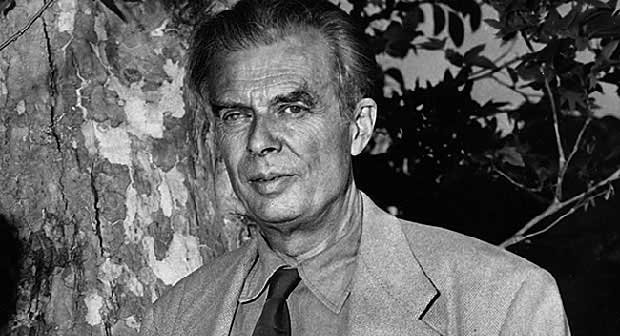
Aldous Huxley is (or was one) of my greatest hero’s when I was a young man. I first read Brave New World, Doors of Perception, Island & The Perennial Philosophy. I also read a few of his articles and other works. Each book had its own influence on me, carving out my thought processes, making me deeply think about life in all its dimensions. Huxley was really one of the principle reasons I ever went to thinking in the first place. He showed me just what can be achieved with the mind, a pen (and some psychodelics).
Who he was
Aldous Huxley (1894–1963) was an English novelist and essayist from a famous scientific family: his grandfather Thomas Henry Huxley was “Darwin’s bulldog”, and his brother Julian was a leading biologist and the first director of UNESCO. A childhood eye disease left him nearly blind as a teenager, which ended his hopes of a medical career and pushed him toward writing. He moved to California in 1937, worked on Hollywood screenplays, and spent his later decades exploring mysticism, meditation and, famously, psychedelics. He died on 22 November 1963, the same day as C. S. Lewis and John F. Kennedy.
The plain idea
Huxley’s life’s work circles one question: how can human beings be free and fully awake in a world that would rather keep them comfortable and asleep? He attacked the question from two directions: as a warning (Brave New World) and as a search for a way out (The Perennial Philosophy, The Doors of Perception, Island).
Why it matters
Brave New World (1932): control by pleasure
George Orwell’s Nineteen Eighty-Four imagines tyranny by pain: surveillance, torture, fear. Huxley imagined something subtler. In his World State, people are engineered in hatcheries into castes, conditioned in their sleep, kept busy with consumer goods and casual sex, and soothed with a drug called soma. Nobody needs to be forced, because nobody wants to rebel. The cultural critic Neil Postman put the contrast perfectly in 1985: Orwell feared those who would ban books; Huxley feared there would be no reason to ban one, because no one would want to read one.
In an age of infinite entertainment feeds, algorithmic recommendation and mood-management by app, many readers think Huxley’s was the more accurate prophecy. He thought so too: in Brave New World Revisited (1958) he argued the world was moving toward his vision faster than he had expected.
The Perennial Philosophy (1945): one truth under many religions
Huxley gathered passages from Hindu, Buddhist, Taoist, Christian, Sufi and other mystics and argued that beneath their different doctrines lies a common core: that there is a divine ground of being, that it can be known directly, and that the purpose of human life is to realise one’s identity with it. Scholars have criticised the idea for ironing out real differences between traditions, but it shaped the spiritual interests of the 1960s and remains a gateway for many readers (see Advaita).
The Doors of Perception (1954): the mind as a reducing valve
After taking mescaline under supervision in 1953, Huxley proposed that the brain works as a “reducing valve”, filtering the overwhelming flood of “Mind at Large” down to the trickle useful for survival. Psychedelics, on this view, open the valve. The title comes from William Blake, and gave the band The Doors their name. See the Doors of Perception page.
Interestingly, some modern neuroscience echoes the metaphor: brain-imaging studies of psychedelics report reduced activity in the “default mode network”, and researchers such as Robin Carhart-Harris have described these drugs as relaxing the brain’s top-down filters. The science is still young, and Huxley’s metaphysics of “Mind at Large” is not something those studies establish.
Island (1962): the utopia
His last novel imagines the opposite of Brave New World: a society on the island of Pala that combines Buddhist mindfulness, Western science, a ritual psychedelic (“moksha medicine”) and humane education. It ends badly, swallowed by an oil-hungry neighbouring dictatorship, which tells you how optimistic Huxley really was.
An everyday analogy: the comfortable cage
Imagine a zoo enclosure so spacious, well-fed and entertaining that the animals never notice the fence. That is Brave New World. Huxley’s later books are about learning to notice the fence, and then discovering that the most important fences are in your own perception.
A worked example: soma today
Ask what plays the role of soma in your own day. It doesn’t have to be a drug. It is anything that reliably removes discomfort without changing anything: the reflexive scroll, the background show, the snack you didn’t want. Huxley’s test is simple: does this make me more aware, or less? Applied honestly for one day, it is a surprisingly revealing exercise.
Common misconceptions
- “Huxley promoted recreational drug use.” He thought psychedelics should be used rarely, carefully and with serious intent, and worried about their misuse. He did, at his own request, receive LSD on his deathbed.
- “Brave New World is about a cruel dictatorship.” Its horror is that it is not cruel. Almost everyone is content.
- “He was only a novelist.” He was one of the most widely read essayists of the century, on science, art, religion and politics.
How it connects
The truth revealed: the most effective prison is the one you enjoy, and the first step out is simply to see it.