
Philosophy | Economics | Politics | Ethics | Aesthetics | philosophers2study
Jeremy Bentham
(1748 - 1832)
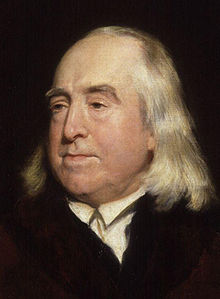
 He is best known as the founder of Utilitarianism, which
 he saw as the underlying moral principle on which his legal
 and social reforms should be based. Although his influence
 during his life was perhaps minor, his impact was greater
 in later years as his ideas were carried on by followers
 such as John Stuart Mill, Robert Owen and John Austin.
The plain idea
Bentham’s big idea fits in one line: the right action is the one that produces the greatest happiness for the greatest number. He opened his Introduction to the Principles of Morals and Legislation (printed 1780, published 1789) with: “Nature has placed mankind under the governance of two sovereign masters, pain and pleasure.” Everything else in his ethics follows from taking that seriously and then counting.
This is utilitarianism, the best-known form of consequentialism: judge actions by their results, not by rules, traditions or intentions.
Why it matters
Bentham was not an armchair thinker; he wanted to fix the law, and his yardstick was radical for his time. If what matters is pain and pleasure, then:
- Everyone counts equally. A poor man’s suffering weighs the same as a lord’s. That was a political bombshell in 18th-century Britain.
- Animals count. “The question is not, Can they reason? nor, Can they talk? but, Can they suffer?” That sentence is the founding text of the animal welfare movement.
- Laws need justifying. He argued for the decriminalisation of homosexuality (in an essay written around 1785 and not published until the 1970s), for the separation of church and state, for women’s rights, and for the abolition of slavery and of physical punishment of children, all on the grounds that these laws caused suffering and prevented none.
His heirs, especially John Stuart Mill, turned utilitarianism into one of the three great families of modern ethics. Today its descendants shape cost-benefit analysis in government, public health decisions, welfare economics and the “effective altruism” movement.
The felicific calculus
Bentham proposed measuring pleasures and pains by seven features: intensity, duration, certainty, propinquity (how soon), fecundity (whether it leads to more pleasure), purity (whether it is free of later pain) and extent (how many people it affects).
A worked example
A town must choose between building a park or a car park. Suppose (generously simplified) the park gives 1,000 residents 2 units of pleasure each per year, while the car park gives 300 commuters 5 units each but adds noise costing 200 neighbours 1 unit each.
Bentham says build the park. Real cost-benefit analysis in planning departments works on just this pattern, with money standing in for “units of pleasure”.
An everyday analogy: the household budget
Utilitarianism treats morality like a family budget: add up the gains, subtract the costs, choose the option with the best bottom line. That is its strength (it is practical, impartial and forces you to look at actual effects) and its weakness (some things don’t seem to fit on a spreadsheet).
The objections, honestly
- Measurement. Can happiness really be added up across people? Bentham thought “pushpin is as good as poetry” if it gives equal pleasure. Mill disagreed and distinguished “higher” and “lower” pleasures.
- Justice and rights. If framing one innocent person would calm a riot and save many lives, the raw calculus seems to recommend it. Most people think that’s monstrous. Rule utilitarians reply that a rule against framing innocents produces more happiness in the long run.
- Demandingness. If every pound you spend on yourself could save more happiness elsewhere, must you give almost everything away? Peter Singer says, roughly, yes.
Common misconceptions
- “Utilitarianism means the ends justify any means.” The means are part of the consequences. Cruelty, fear and broken trust count against an action.
- “It’s selfish hedonism.” The opposite: your own pleasure counts for exactly one, no more.
- “Bentham invented the idea.” Francis Hutcheson used “the greatest happiness for the greatest numbers” in 1725, and Epicurus put pleasure at the centre of ethics two millennia earlier. Bentham’s contribution was to make it systematic and apply it to law.
Two curiosities
Bentham designed the Panopticon, a circular prison where one guard could watch every cell unseen; Michel Foucault later made it the symbol of modern surveillance. And by his own wish, his preserved skeleton, dressed in his clothes with a wax head, the “Auto-Icon”, sits on public display at University College London.
How it connects
- Epicurus: the ancient pleasure-centred ethics.
- Philosophical Terms: consequentialism versus duty and virtue.
- Economics and Politics: utility, welfare and policy.
- Philosophers to Study
The truth revealed: Bentham’s question, “does it actually make anyone’s life better or worse?”, is still the sharpest test you can put to a law.
Links, Sources & Reading Lists
Jeremy Bentham, An Introduction to the Principles of Morals and Legislation (1789)
John Stuart Mill, Utilitarianism (1861)