
Philosophy | Economics | Politics | Ethics | Aesthetics
Ludwig Wittgenstein
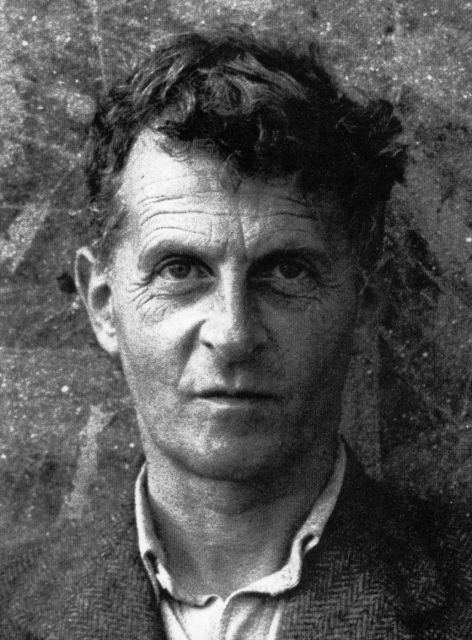
  Wittgensteins's Tractus may be called a synthesis of the theory
  of truth-functions and the idea that language is a picture of
  reality.

  Out of this synthesis arises a third main ingredient of the book,
  its doctrine of that which cannot be said, only shown.

  Ludwig Wittgenstein A Memoir by Norman Malcom
Date: 30/11/2016
He had a habit of writing thing down in note books. Like him, I too have a scattering of note books but unlike him, mine are not so organised or dated. There is a beauty to note taking. Something in it that sharpens the mind. It makes you think with greater precision and clarity and acts as a reference at future dates often bringing back more than what is immediately written down.
Wittgenstein was a friend and contemporary to:
- Bertrand Russell
- Frege
- G.H. Hardy
- G.E. Moore
- A.N. Whitehead
- J.M. Keynes
He was also influenced by:
- Schopenhauer
- Spinoza
- Tolstoy
- The Gospels
After the death of his father in 1912, Wittgenstein inherited a fortune. He promptly gave it all away, choosing a life of extreme simplicity and frugality. Despite choosing this life, I find his life most fascinating. Wittgenstein fought in The Great War, he was a gifted musician, conductor, an artist, architect, sculptor and more. He was member of the Royal Society and the chair of Philosophy in Cambridge.
The plain idea
Ludwig Wittgenstein (1889–1951) is the rare philosopher who produced two revolutionary philosophies, and the second one demolished the first.
- The early Wittgenstein, in the Tractatus Logico-Philosophicus (1921), argued that language works by picturing the world. A sentence is meaningful because its structure mirrors a possible arrangement of things; it is true if things are actually arranged that way. Whatever cannot be pictured, including ethics, aesthetics, the meaning of life, and the Tractatus’s own propositions, cannot be said, only shown. The book ends: “Whereof one cannot speak, thereof one must be silent.”
- The later Wittgenstein, in the Philosophical Investigations (published 1953, after his death), argued that meaning is use. Words are not labels stuck on things; they are tools in a vast variety of human activities, which he called language games: giving orders, telling jokes, praying, reporting, greeting. To understand a word, look at how it is actually used in a “form of life”.
Why it matters
- The Tractatus inspired the Vienna Circle and logical positivism, one of the most influential movements of 20th-century philosophy (though Wittgenstein felt they misread him).
- The Investigations reshaped the philosophy of language and mind, influenced linguistics, anthropology and social theory, and gave thinkers such as Richard Rorty the idea that there is no standpoint outside all language games.
- His therapeutic idea of philosophy is still provocative: many philosophical problems, he thought, are not deep puzzles about reality but knots in our language, “bewitchment of our intelligence by means of language”. Philosophy’s job is to untie them, “to show the fly the way out of the fly-bottle”.
- And in the age of large language models, which learn what words mean almost entirely from how they are used, “meaning is use” looks unexpectedly practical.
An everyday analogy: what is a game?
Wittgenstein’s famous challenge: define “game”. Board games, ball games, card games, solitaire, ring-a-ring o’ roses. Not all have winners; not all have rules written down; not all involve skill or luck or more than one person. There is no single feature they all share. Instead they overlap like the members of a family: one has the nose, another the eyes, a third the walk. He called this family resemblance, and it means many of our most useful words have no sharp definition, and don’t need one.
A worked example: “Five red apples”
Wittgenstein opens the Investigations with a shopkeeper who is handed a slip reading “five red apples”. He opens the drawer marked “apples”, looks up “red” on a colour chart, and counts “one, two, three, four, five”, taking an apple each time.
Now ask: what does “five” mean? There is no object called five in the drawer. The meaning of “five” is shown entirely in what the shopkeeper does with it, the counting. Compare that with the Tractatus picture, where each word names an object. One small shop scene and the picture theory starts to crack.
The beetle in the box
Another thought experiment, aimed at the idea of a purely private inner language: suppose everyone has a box with something they call a “beetle” inside, and nobody can look into anyone else’s box. Then the word “beetle” can’t get its meaning from the thing in the box. The thing could be different for everyone, or nothing at all, and the word would still work the same way in conversation. His point was not that sensations don’t exist, but that the meaning of words like “pain” is anchored in shared public life, not in private inspection.
Common misconceptions
- “The Tractatus says ethics is nonsense, so unimportant.” Wittgenstein said the opposite: the unsayable part was the important part. He wrote that the book’s point was ethical.
- “Meaning is use” means words can mean anything. Use is governed by shared practices and rules; you can use a word wrongly.
- “He was a logician only.” He was also an engineer (he studied aeronautics in Manchester), a decorated soldier in the First World War, a village schoolteacher in Austria, the architect of a house in Vienna for his sister, and a hospital porter in London during the Second World War.
How it connects
- Logic: the truth-functions of the Tractatus are the truth tables of propositional logic, which Wittgenstein helped popularise.
- Richard Rorty: language games without a view from nowhere.
- Philosophical Terms and Philosophy
The truth revealed: often the problem isn’t the world, it’s the way we’re talking about it.
Sources and Links
Ludwig Wittgenstein, Philosophical Investigations (1953)
Ray Monk, Ludwig Wittgenstein: The Duty of Genius (1990), the best biography