
Richard Rorty
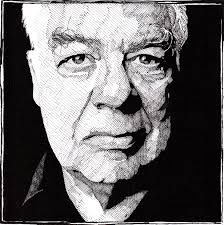
The American philosopher Richard Rorty, thought that there might in fact still be something behind the world as it appears to us. However, he thought that this could play no role for us as human beings, so he instead suggested that we increase solidarity among human beings rather than look for ultimate Truth (with a capital T) or ultimate Reality (with a capital R).
Rorty concluded that there is no position outside historically situated language games from which to distinguish mind from world.
Criteria for choosing among scientific theories—like criteria for determining the truth of sentences or for distinguishing fact from theory, analytic from synthetic, or intuitions from concepts—can emerge only out of particular language games, and the project of trying to ground knowledge claims in representations outside all such games is a hopeless endeavor.
Who he was
Richard Rorty (1931–2007) was an American philosopher who taught at Princeton, Virginia and Stanford. He began as a skilled analytic philosopher, then in Philosophy and the Mirror of Nature (1979) turned on the whole project of his profession. Later books include Contingency, Irony, and Solidarity (1989) and Achieving Our Country (1998). He called himself a neopragmatist, an heir to the American pragmatists William James and John Dewey.
The plain idea
For most of its history, Western philosophy has pictured the mind as a mirror and knowledge as an accurate reflection of reality. The philosopher’s job was to polish the mirror: to find the foundations that guarantee our beliefs match the world as it really is. Rorty’s claim was that this picture is a mistake, and that we should simply drop it.
His alternative: treat beliefs as tools, not pictures. A belief is good when it helps us cope, predict, cooperate and live better. “True”, on this view, is a compliment we pay to beliefs that have proven themselves in conversation and practice, not a magical fit between sentences and a world that exists independently of any description. That is what the paragraphs above mean by “no position outside historically situated language games”.
Why it matters
- It challenges the foundations project that runs from Descartes through Kant to much of 20th-century analytic philosophy. Rorty argued that thinkers like Wittgenstein, Heidegger, Dewey, Quine and Sellars had already undermined it from different directions; he connected their critiques.
- It shifts philosophy’s job from discovering eternal truths to keeping “the conversation of mankind” going: comparing vocabularies, imagining better ones, and widening the circle of people we care about.
- Solidarity over objectivity. If we can’t ground morality in a view from nowhere, Rorty argued, we can still expand it through stories, journalism and novels that help us see strangers as “one of us”. Liberal society, for him, rests on the hope of reducing cruelty, not on a proof.
- A strange prophecy. In Achieving Our Country he warned that if the American left abandoned economic concerns of working people for purely cultural politics, voters would eventually turn to a “strongman” who promised to stand up for them. After 2016 that passage went viral.
An everyday analogy: tools in a toolbox
Is a hammer “true”? The question doesn’t make sense. A hammer is good for nails and bad for screws. Rorty thought “Does this sentence correspond to reality?” was often a similarly confused question. Better to ask: what does this vocabulary let us do? Newtonian physics is an excellent tool for bridges and a poor one for GPS satellites, where relativity does better. We replace tools when better ones come along; we don’t need to believe the new one finally mirrors reality as it is in itself.
A worked example: the liberal ironist
Rorty’s ideal citizen is the liberal ironist:
- Ironist: she knows her deepest beliefs and her “final vocabulary” are contingent; she might have had different ones had she been born elsewhere, and she stays open to redescription.
- Liberal: she thinks “cruelty is the worst thing we do”.
- The puzzle: if her values are contingent, why stand up for them? Rorty’s answer is that contingency doesn’t make commitment weaker. You can know your marriage could have been to someone else and still be completely loyal to it.
Common misconceptions
- “Rorty said anything goes.” He thought some beliefs work far better than others; he just denied that philosophy could prove it from outside all practices.
- “He denied there’s a real world.” He accepted that the world causes our beliefs (rocks hurt when you kick them). What he rejected was the idea that the world chooses between descriptions for us.
- “He was a postmodernist like the French theorists.” He drew on Derrida and Foucault but was rooted in American pragmatism, and was openly patriotic and reformist.
How it connects
- Ludwig Wittgenstein: the “language games” Rorty relies on.
- Philosophical Terms: epistemology and metaphysics, the debates Rorty wanted to retire.
- Jordan B. Peterson: a sharp critic of the postmodern currents Rorty is often grouped with.
- Philosophy
The truth revealed, Rorty style: maybe there is no final truth to reveal, only better and worse ways of talking, and the better ones make us kinder.
Links
Richard Rorty - The Making of an American Philosopher - Neil Gross
Richard Rorty, Philosophy and the Mirror of Nature (1979)
Richard Rorty, Contingency, Irony, and Solidarity (1989)