
The Demon Who Liked Squares
What the ever hell is Energy?
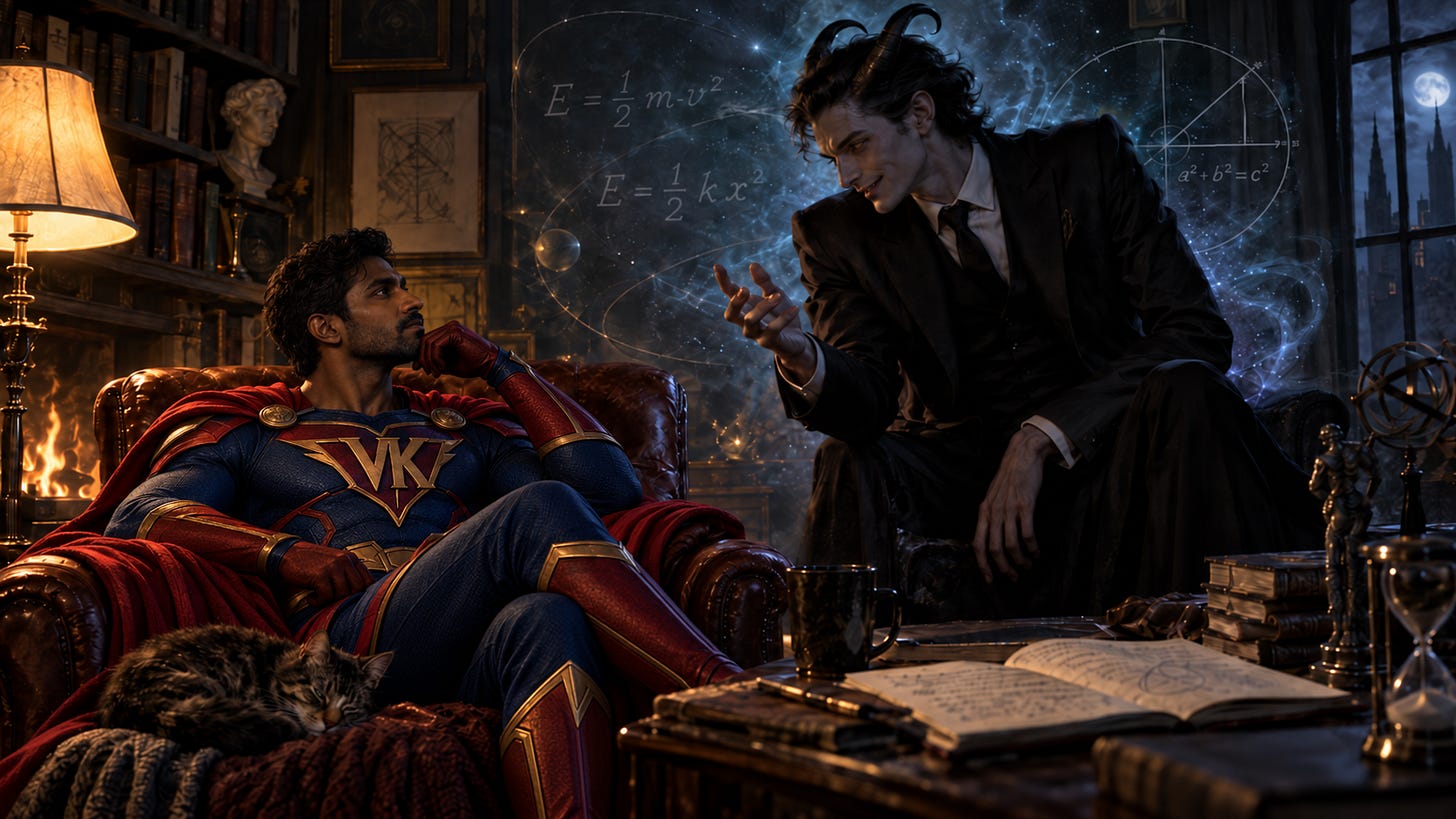
I was lying in my favourite armchair doing absolutely nothing.
This is an activity I have perfected over many years.
Thanks for reading! Subscribe for free to receive new posts and support my work.
There is a point, usually about twenty minutes in, when doing nothing ceases to feel like laziness and begins to feel philosophical. The body sinks into the chair. The mind, freed from productive activity, starts wandering into places it has no business going.
On this particular afternoon it wandered into Physics.
This was unfortunate.
I had been thinking about energy, or my lack of it.
Not worrying about the electricity bill, or whether I had enough energy to get out of the chair.
Actual Energy.
The thing physicists put into equations. The thing that supposedly moves from one form to another. The thing that cannot be created or destroyed.
I realised I had no idea what it was butI knew all the usual answers.
Energy is the capacity to do work.
Energy cannot be created or destroyed.
Energy comes in different forms.
Kinetic energy. Potential energy. Electrical energy. Heat. Light.
All perfectly respectable answers. Except none of them answered the question.
What is energy?
At that moment the room became noticeably colder. This is generally a bad sign.
A black shape appeared beside the bookshelf, stretched upward and slowly resolved itself into a tall gentleman in an immaculate dark suit.
He had horns, not enormous horns, tasteful ones.
He looked at me with the weary expression of someone who had already answered this question several thousand times.
“Energy,” he said, “is the capacity to do work.”
I stared at him.
“What?”
“You were asking what energy is.”
“Yes.”
“And I have answered.”
“No. You have told me what energy can do.”
His smile tightened.
“It is the accepted definition.”
“That makes it no less evasive.”
He sighed, demons apparently dislike pedantry.
“Who are you?” I asked.
“Dynamis.”
“Greek?”
He gave a small bow.
“Ancient.”
I made a note of the name, it would matter later.
The First Trick
“Fine,” Dynamis said. “Energy is a quantity possessed by physical systems.”
“That is worse.”
“Why?”
“Because now you have merely replaced the word energy with the word quantity.”
“A moving object has energy.”
“Yes.”
“A stretched spring has energy.”
“Yes.”
“A battery has energy.”
“Yes.”
“A hot object has energy.”
“Yes.”
“Light carries energy.”
“Yes.”
“So there you are.”
“No. There I am surrounded by five completely different things which you insist possess the same mysterious property.”
Dynamis walked over to the window.
“You mortals always want everything to be a substance.”
“I haven’t said it is a substance.”
“You were about to.”
“I might have been.”
He smiled. Then something occurred to me.
“There is something strange about all the Energy equations.”
He turned.
“What?”
“They keep having squares in them.”
The smile disappeared and that was interesting…
“You’re not afraid of a little Math are you?”
Dynamis shifted.
“Demons have superior Mathematics than humans; I travel by wormhole after all…”
I got out my notebook and started sketching a solution.
The Squares
For a moving object,
For a spring,
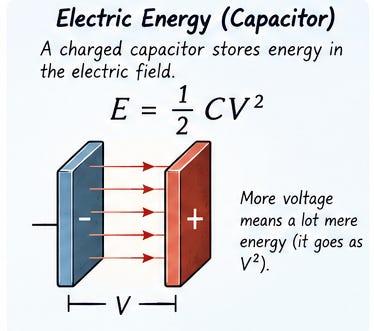
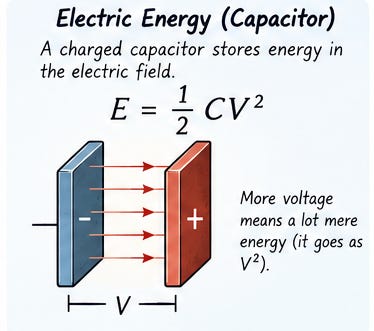
For a capacitor,
For an inductor,
Velocity, Displacement, Voltage, Current… each squared;
that little 2 as a superscript means v times v, x times x, etc…
“Why?” I asked.
“Coincidence.”
“Four coincidences?”
“Physics contains many coincidences.”
This was clearly a lie.
“So what does velocity squared mean?”
Dynamis said nothing.
I pondered, “Velocity itself makes immediate sense. If I am moving at ten metres per second, I know what that means.”
But, 10²
is odd.
I am not somehow moving through one hundred square metres every square second.
So what has physics gained by squaring the velocity?
Dynamis inspected one of his fingernails, “Nothing important.”
Which meant it was probably extremely important…
What Does a Square Mean?
We first learn squaring through area.
A length of five metres gives a square of twenty-five square metres.
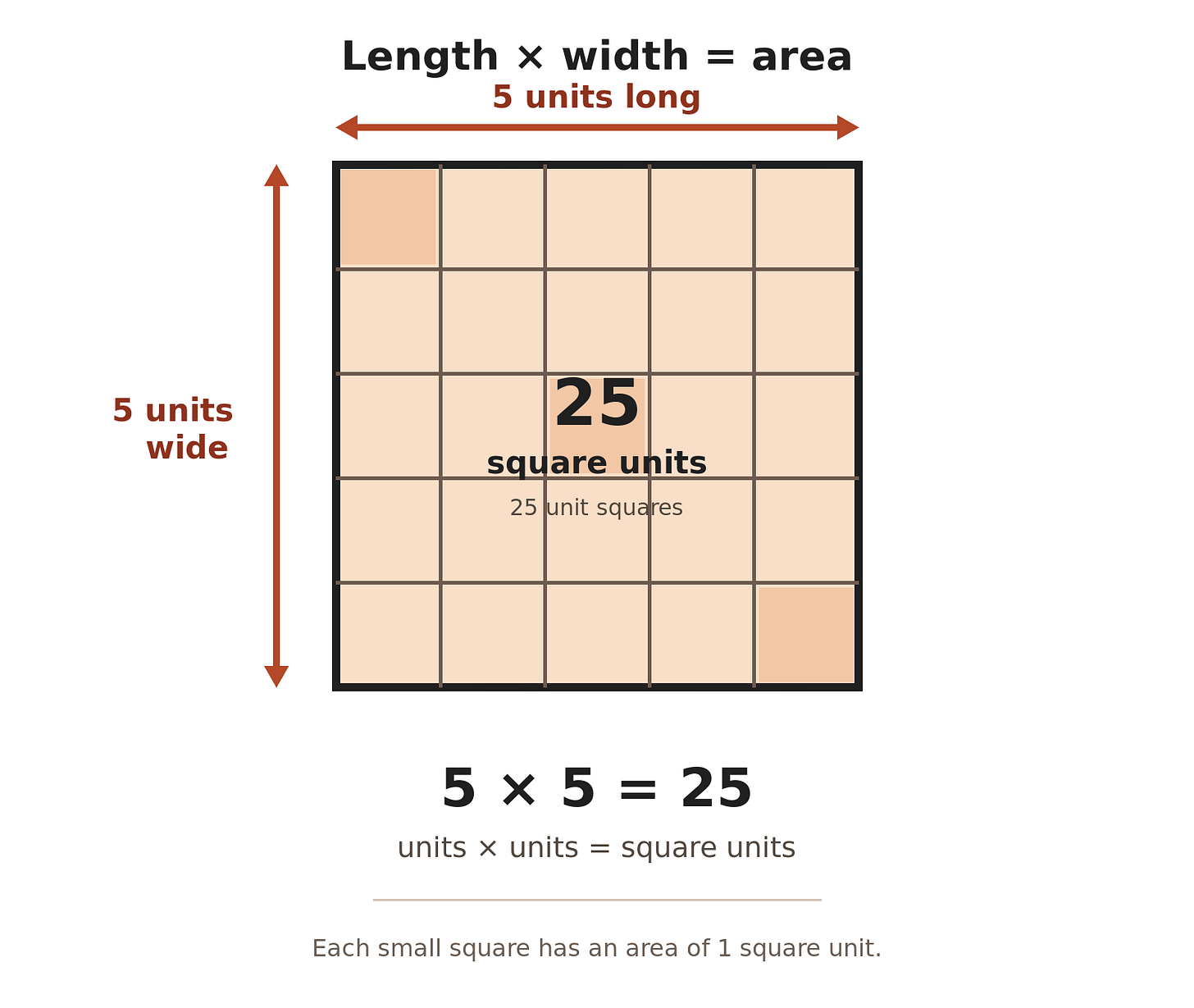
So it is tempting to assume that the square of every quantity somehow represents an area.
But that is not really what is happening here. We need vectors.
“Hey demon, you know what vectors are?”
“You take me for a buffoon?” he asked, “ but please continue; I want to know what you think they are…”
I suspected he wasn’t as clever as he was pretending to be…
So I started…
A vector is simply a quantity that has both a size and a direction.
Speed on its own is not a vector.
If I say I am travelling at 5 km/h, you know how fast I am going, but not where.
Velocity is a vector. If I say I am travelling at 5 km/h north-east, I have given you both the size and the direction.
or i can write it as (3,4), go 3 east and 4 north.
Check it yourself; you’re going 5 north-west.
In some sense, “5 north-west” can be written down as a pair of two numbers (3,4).
Take a vector:
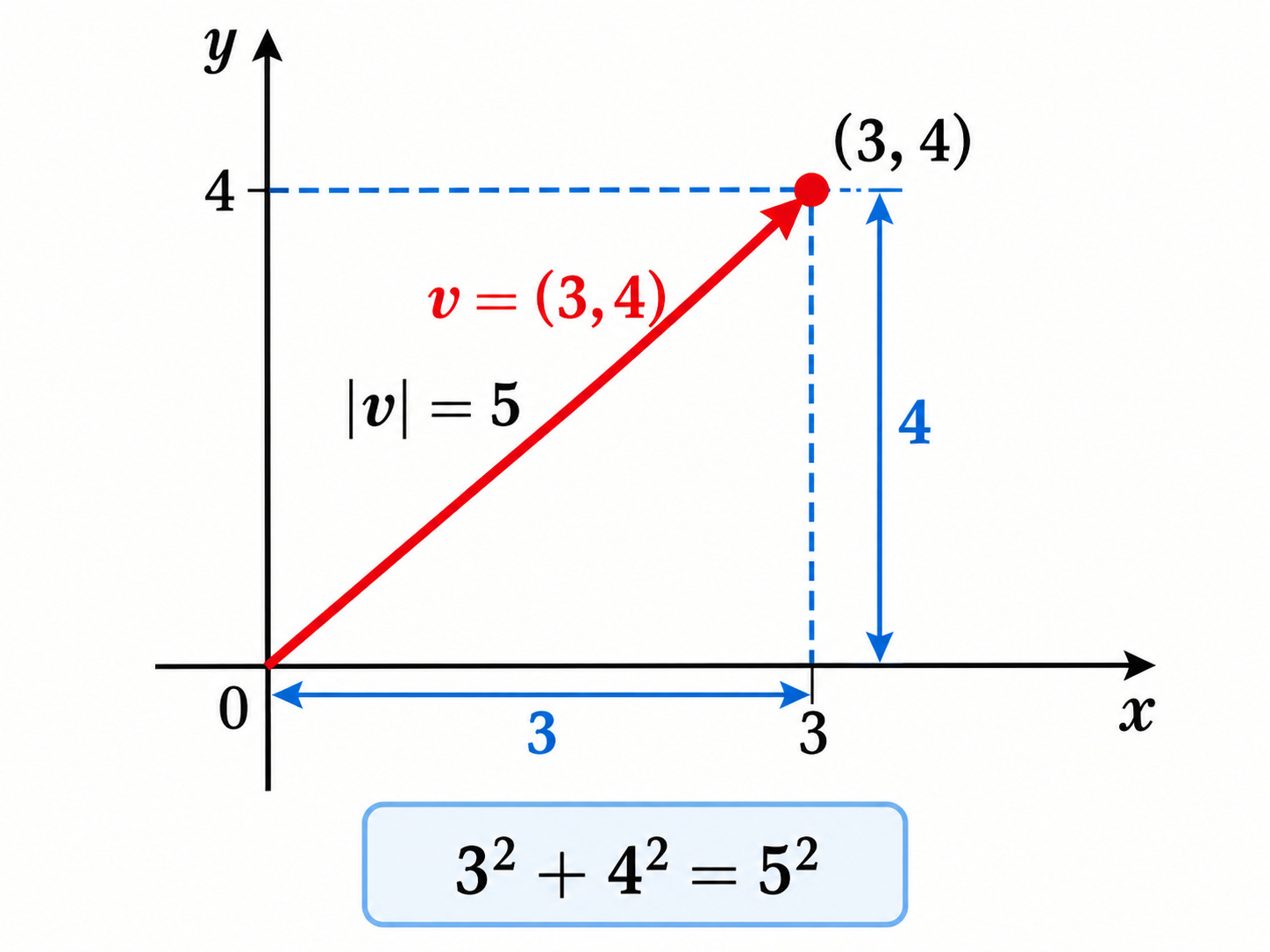
Its magnitude is
Its squared magnitude is
Mathematically, the vector is multiplied by itself.
The square gives a scalar measure of its magnitude. Direction disappears.
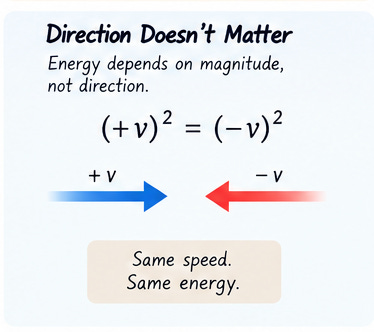
A velocity of
and one of
are opposites as vectors. The first goes East, the second west.
But
From the perspective of kinetic energy, they are identical.
“Energy is a measure, it is not a thing”
A car travelling east at ten metres per second has the same kinetic energy as the same car travelling west at ten metres per second.
Energy cares about how much motion there is.
Not which way it points, but there was something more important hiding in the square…
Pythagoras
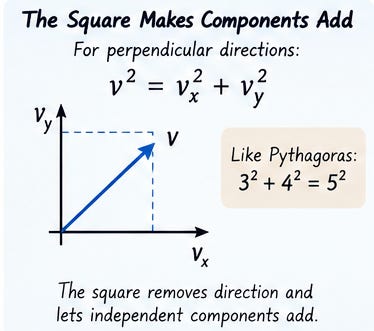
v_(x) and v_(y) just mean the amount of velocity in the x and y direction.
Suppose I move three metres east and four metres north.
The straight-line distance is five metres. Not seven. The components do not simply add but their squares do…
That is Pythagoras. Something we take for granted.
Now consider velocity. Suppose my velocity has components v_(x) and v_(y)_(.)
The magnitude satisfies
Exactly the same structure! I sat up slightly in the chair.
Dynamis noticed.
“So?”
“So the square is doing two things.”
“What?”
“It removes direction and makes independent perpendicular components additive.”
He frowned.
I continued…
Kinetic energy is
So in two dimensions,
Or expanding the brackets,
Each independent direction contributes separately to the total energy.
The total energy is additive.
The squared components are additive.
That felt less accidental. The square was not merely making numbers bigger. It was converting a directional quantity into something that could be added cleanly across independent directions.
Dynamis shifted uncomfortably.
I sank back into the chair.
“So energy likes squares because squares behave additively.”
“An oversimplification.”
“Yes… but those are often useful.”
The Spring
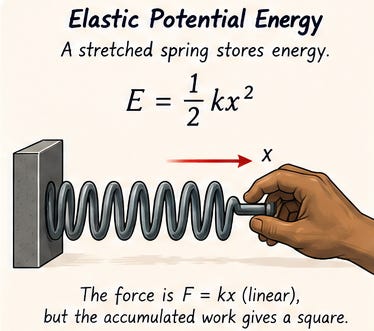
Then there was another clue.
Why does a spring store
rather than simply
If we remember, Hooke’s law says
The further I stretch the spring, the harder it pulls back.
But energy is not the final force.
Energy is the work accumulated while stretching it.
“I hope you don’t mind a little calculus Dynamis? It can be safely ignored. I am just working things out, the result is important.”
Therefore,
If
then substituting kx for F,
and integrating, we get
The square emerges naturally. The force grows linearly. The work accumulates.
Linear response becomes quadratic energy.
Dynamis was now pacing.
“Please, sit down, things are about to get complicated.” I said.
Motion Does the Same Thing
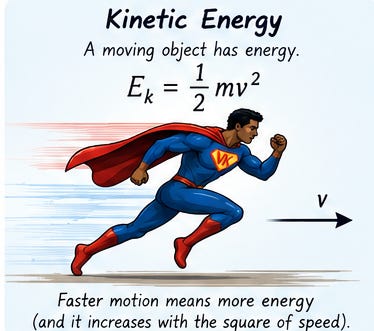
Kinetic energy follows a similar path.
Work is
Newton tells us
And acceleration (change in velocity over time) can be written as
noticing dx/dt is velocity, v. We can simplify to…
Multiplying both sides by (dx),
Therefore,
Integrating again,
gives
Again, the square is not arbitrarily inserted into the equation.** Its a half because the area of a triangle is half of the breath x width. **
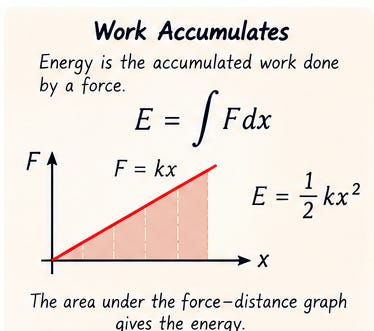
It appears because energy is accumulated change.
The Same Pattern repeats elsewhere…
The same thing happens in electrical systems.
For a capacitor,
For an inductor,
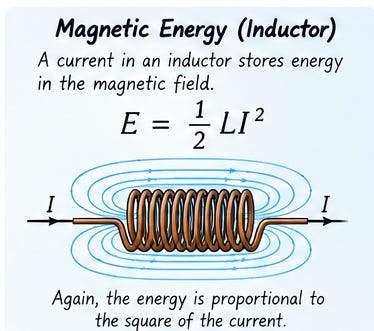
Different physical systems. Different quantities.
Same quadratic pattern.
Mass tells us how strongly velocity contributes.
Stiffness tells us how strongly displacement contributes.
Capacitance tells us how voltage contributes.
Inductance tells us how current contributes.
In each case there is a physical constant acting almost like a ruler.
The square tells us magnitude.
The constant tells us how heavily that magnitude should count.
“So,” I said, “perhaps energy isn’t some invisible stuff inside the object.”
Dynamis stopped pacing.
“Of course it is something.”
“What sort of thing?”
“A substance.”
“Where is it?”
“Inside the system.”
“Inside which part?”
“All of it.”
“Can I isolate some?”
“You can transfer it.”
“That wasn’t my question.”
He glared at me.
I continued…
When a ball falls, gravitational potential energy becomes kinetic energy. When it strikes the ground, that energy becomes sound, heat and deformation.
It is extremely tempting to imagine some invisible fluid flowing between labelled containers.
Potential.
Kinetic.
Heat.
Sound.
Schools encourage this because the picture is useful.
But useful pictures can become dangerous when we mistake them for reality.
Nothing obvious is physically pouring from the category marked POTENTIAL ENERGY into the category marked KINETIC ENERGY.
What persists is a number assigned to the physical state of the system.
As the state changes, that number remains constrained and sometimes,** conserved.**
That was beginning to sound more interesting.
A Circle Appears
Consider a mass attached to a spring.
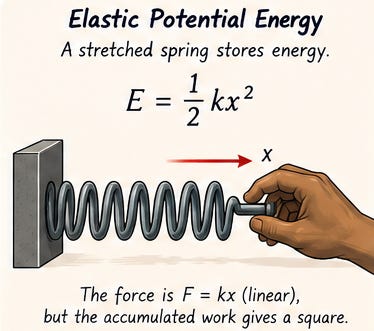
When I let go of the spring and it is oscillating back and forth, its total energy is
Total Energy = Kinetic-Energy + Elastic-Potential-Energy
At the centre, the mass moves fastest, most of the energy is kinetic.
At the ends, the mass momentarily stops, most of the energy is stored in the spring.
We usually say the energy moves backwards and forwards between kinetic and potential forms.
That is perfectly useful language.
But rewrite the equation.
“Stay with me here Demon, we will be done soon…”
Define
and
Then
If the energy is constant,
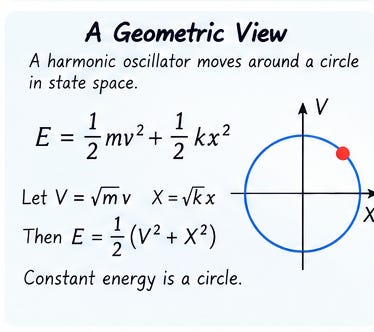
I stared at the equation. Dynamis stared at me.
“That,” I said, “is a circle.”
He said nothing.
The state of the oscillator moves around a circle in a space whose coordinates are scaled position and velocity.
Position changes.
Velocity changes.
Kinetic energy changes.
Potential energy changes.
But the squared distance from the origin remains fixed.
Conservation of Energy had turned into a Geometry.
The system changes while a certain measure of its state remains the same.
Energy as Geometry
*“So you think energy is distance?” *Dynamis asked.
“No.”
“Squared distance?”
“Not literally.”
He smiled, he thought he had me.
But ordinary distance is only one example of a larger mathematical idea.
A geometry tells us how to measure magnitude.
In ordinary Euclidean space,
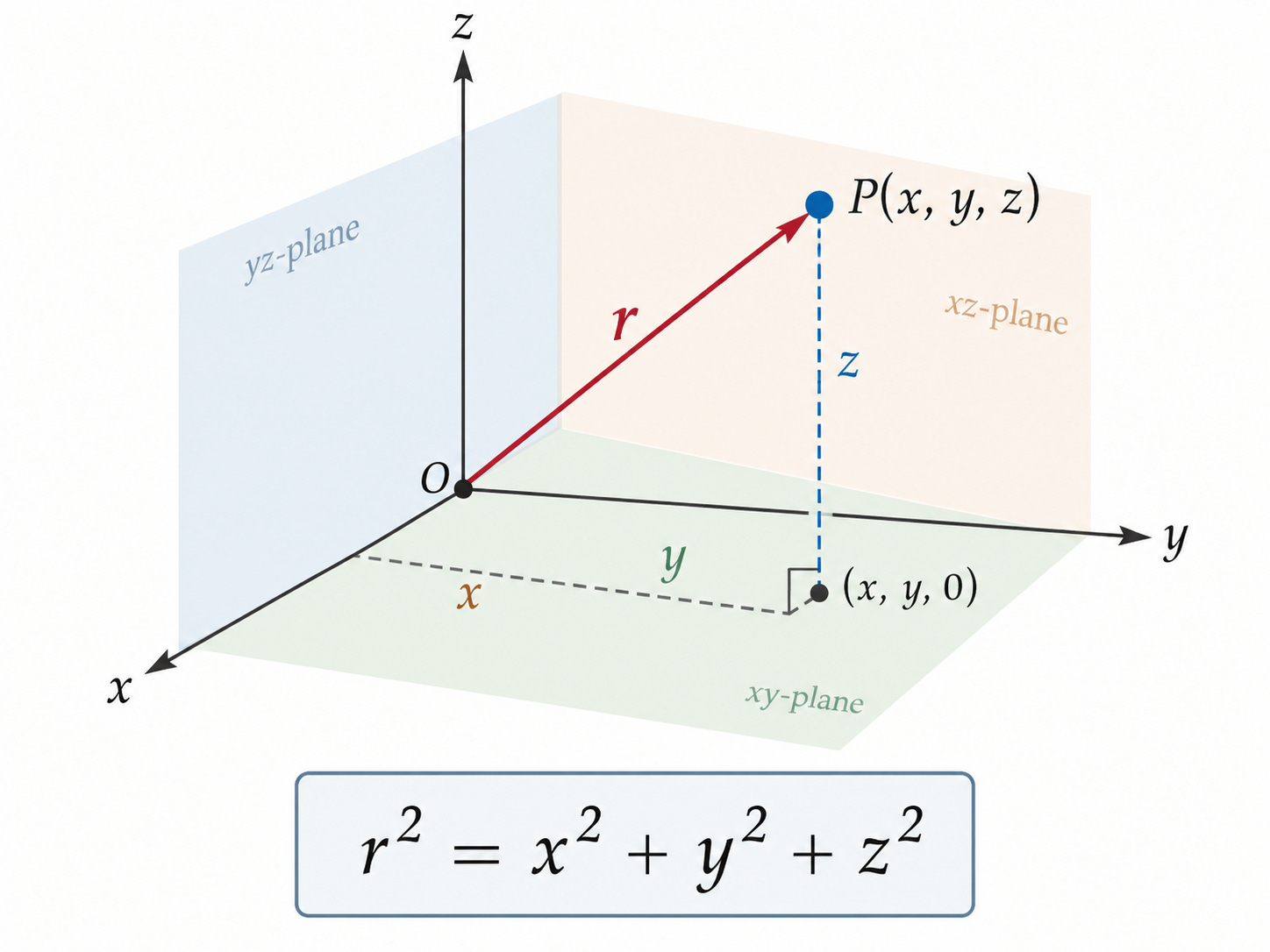
But physical systems can have their own geometry.
“I hope you paid attention in class, this will not be long but will require your full attention”, I warned.
For kinetic energy,
For elastic systems,
These are quadratic forms. They look like generalized versions of squared distance.
Different physics.
Different rulers.
Same mathematical shape.
Energy often behaves like a squared magnitude measured using the particular geometry of the system.
That was beginning to feel closer to an answer.
“This part is for the nerds”, I said, “just follow along for the bonus.”
Why Does Nature Keep Producing Squares? There is a mathematical trick hiding here, but the idea is simpler than the name makes it sound.
If you zoom in closely enough on a smooth curve, you can describe its shape by successively adding simple pieces: a constant, a slope, a bend, then finer corrections.
There is an even deeper reason. Suppose a system is in a stable equilibrium.
Suppose I have some complicated curve describing how the energy of a system changes as I move away from its resting position.
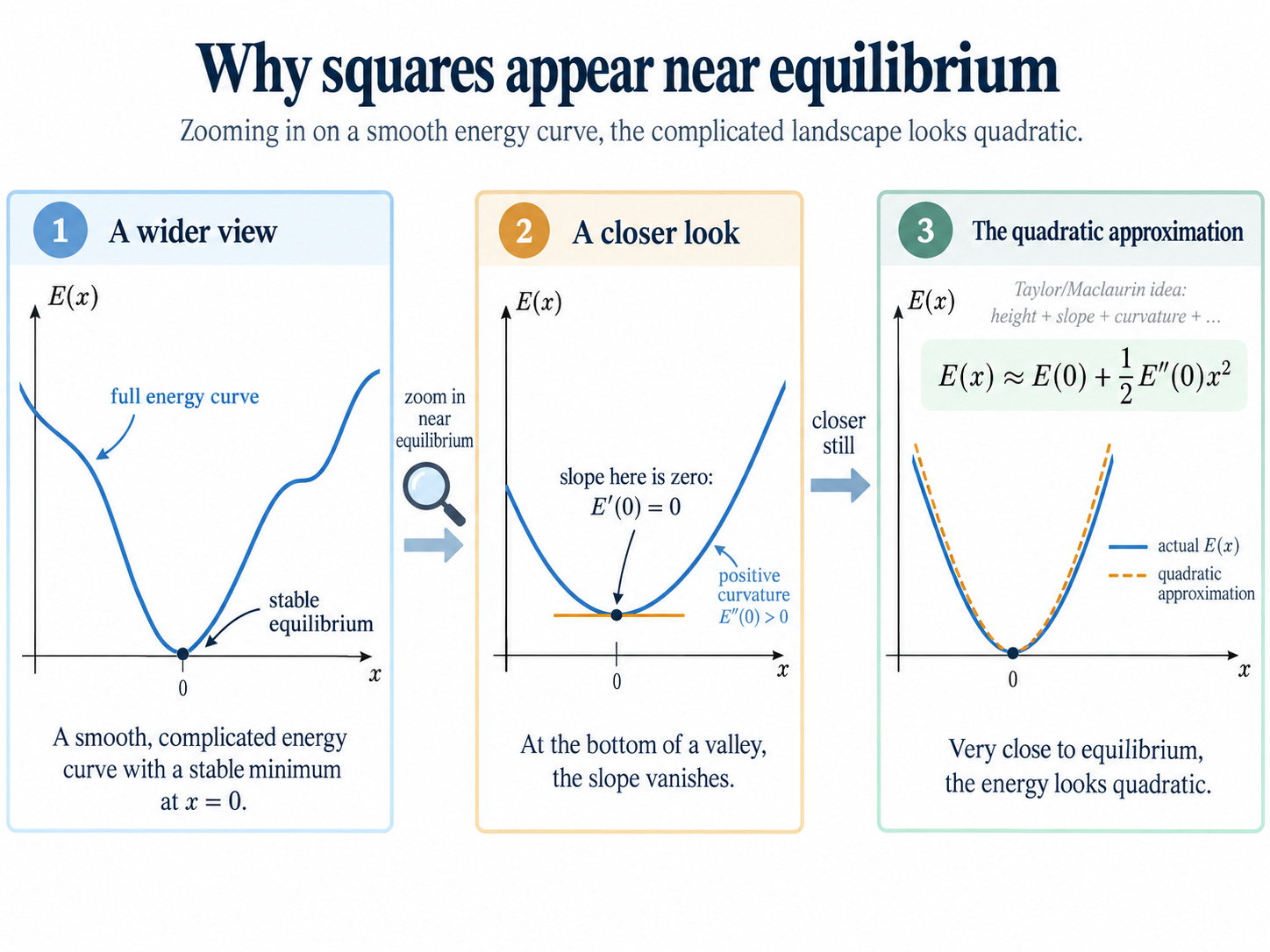
I may not know a simple equation for the whole curve. But if I only care about what happens very close to one particular point, I can build an approximation of it piece by piece.
First I ask:
How high is the curve at that point?
That gives me a constant. It’s chosen by us and set to zero.
Then:
Which way is it sloping?
That gives me a straight-line correction.
Then:
How much is it bending?
That gives me a quadratic, or (x²), correction.
Then come progressively finer corrections involving (x³), (x⁴), and so on.
Written mathematically,
Let its energy depend on some variable (x).
Near (x=0), we can expand the energy using a Maclaurin series:
This is just a Taylor series expanded about zero.
Forget the Complex looking equation. Look at the Geometry. The terminology is less important than the idea.
Now, at a stable equilibrium the energy is at a minimum.
Which means the slope there is zero:
So the linear term disappears.
We are left with
Close enough to equilibrium, the higher-order terms become small, so
E(0) tells us its height. (which we call zero)
E’(0) tells us its slope. (which is zero near the bottom of the curve, the stable position)
E’’(0) tells us its curvature (how much it is bending).
The constant term E(0) merely sets the reference level, which we consider as 0,** so the first term that actually describes how the energy changes is quadratic** ( x² ).
**There is the square again. **Not because nature has some mystical obsession with squares but because stable equilibria kill the linear term E(0).
The quadratic term is the first one left standing.
This is why so many different systems look alike near equilibrium.
Springs.
Pendulums.
Vibrating molecules.
Crystal lattices.
Electrical circuits.
Fields.
Near a stable configuration, they all begin to resemble quadratic systems.
Perhaps nature does not love squares, perhaps** stability** produces them.
Dynamis looked unhappy.
“The Name, Dynamis, something had been bothering me.”
He looked at me, “Yes?”
“What does your name mean?”
He did not answer. I reached for my phone, his expression changed.
“Don’t.”
That was encouraging.
“Greek,” I said. “Dynamis.”
He folded his arms.
“Power.”
“And?”
“Strength.”
“And?”
He sighed, “Capacity.”
I stared at him, he stared back. Then I smiled.
“Of course.”
“What?”
“Your first answer.”
He said nothing.
“Energy is the capacity to do work.”
Silence.
“Of course you think energy is capacity. Your name is Dynamis.”
His eyes narrowed.
In Greek philosophy, Dynamis carries the sense of power, capacity or potential.
And Aristotle contrasts it with energeia.
Actuality
Activity
Being-at-work
The demon had been smuggling his preferred answer into the discussion from the very beginning.
“You came here already committed to the definition.”
“I came here to help.”
“You came here to win.”
“I am a demon.”
“Fair.”
So What Is Energy?
Dynamis stood, “Have you solved it?”
“No.”
He seemed relieved.
“But I think I have removed some bad pictures.”
“Such as?”
“That energy is a substance.”
He shrugged, “And?”
“That squaring quantities is just some mathematical trick.”
Another shrug, “And?”
“That kinetic energy, spring energy, electrical energy and all the others are unrelated formulas we simply have to memorise.”
He stopped shrugging.
Energy appears to be something subtler.
It is a number assigned to the state of a physical system.
A very special number.
It tells us something about what transformations are possible.
It is additive across independent contributions.
And in a huge class of physical systems, especially near stable equilibrium, it takes the form of a quadratic measure.
A squared magnitude. Not necessarily a squared distance in ordinary space.
But something geometrically similar.
Mass provides one ruler.
Stiffness another.
Capacitance another.
Inductance another.
Different systems.
Different rulers.
Same mathematical pattern.
So perhaps a useful way to think about energy is this:
**Energy is often the squared magnitude of a physical state, **
measured using the particular geometry of that system.
Not always, not universally but often enough that the pattern is difficult to ignore.
Dynamis was fading now.
“One problem,” he said.
“What?”
“You still haven’t explained why energy is conserved.”
I looked at him. He smiled. Then vanished. The bastard.
I settled back into my armchair. That would have to wait for another afternoon.
And that’s,
The Vikid Truth
Thanks for reading! Subscribe for free to receive new posts and support my work.