
The Hard Problem
A Chromatic Discussion
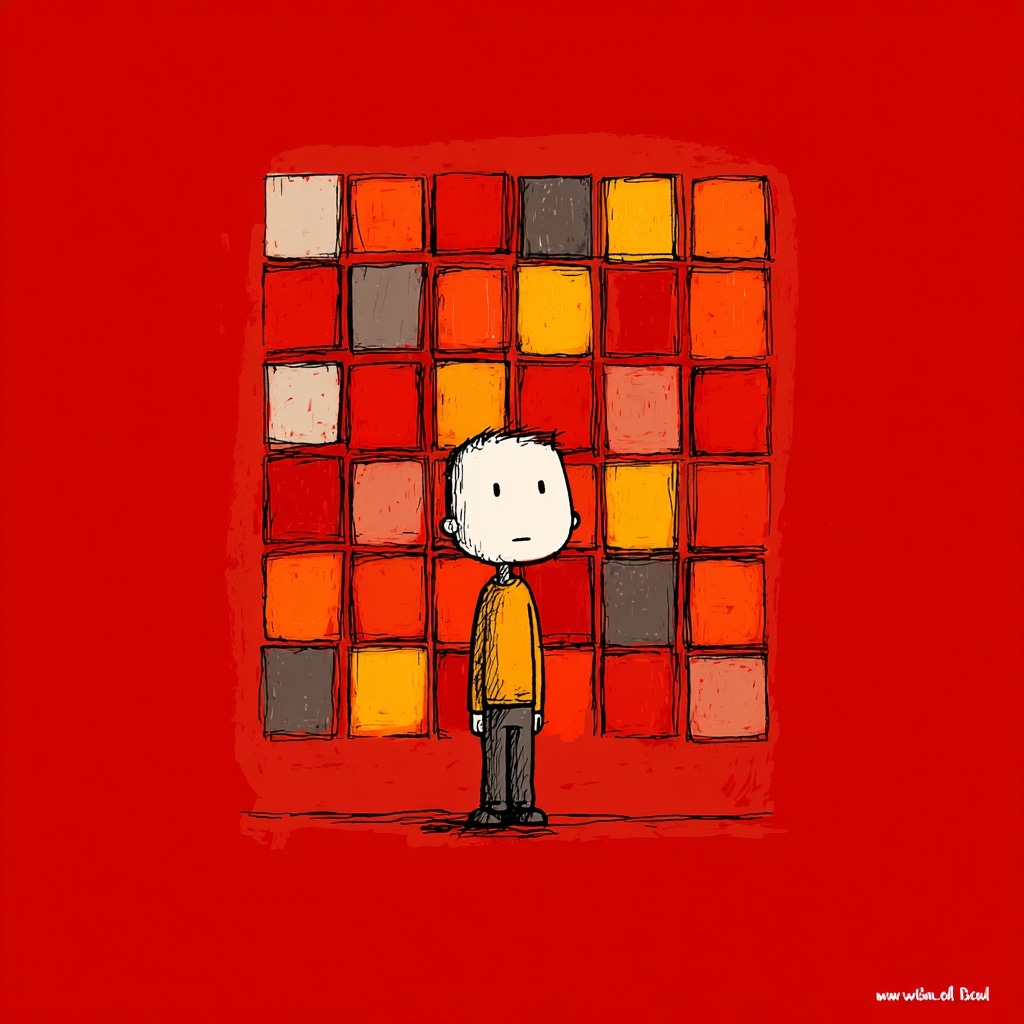
Vikid was a smart man so he decided to embark on a simple investigation. He wanted to learn about the color Red.

He learnt that it was considered a Primary Color. Much like Prime Numbers in mathematics, any color whatsoever could be made using three Primary Colors at different intensities.
Though this made him feel smarter and was very useful information, the problem was it didn’t tell him anything about Red itself, only how to make other colors using Red.
So he put his Science hat on and got himself a magnifying glass. He went up to the LCD TV and looked closely. There he found little glass tubes, neatly organized in rows and columns, glowing on and off at different brightness’. The Red ones were always red, the blue one always blue, etc… and it gave him a clue.
“Color has something to do with light”, he thought. So he got a piece of glass, shining light through it at various different angles. At first he used the sun, a readily available source, then some bulbs and found that he could produce the rainbow, each color occupying a band. Always in the same order.
So he thought, Sun light which looks a whitish yellow, has Red in it. So does the light of a white bulb.
He was getting smarter all the time but still the question remained, “What is Red?” and some corollaries, “Where does it come from?” and “Why does it look Red?”.
So he decided to crack open a book.
It read:
“Physical description of red light.
Visible light is a band of electromagnetic radiation with wavelengths about 400–700 nanometers (nm).
Red light corresponds to the long‑wavelength end of this band, roughly 620–750 nm, with a typical value often quoted around 700–740 nm.
Because frequency
and wavelength
are related by
the longer wavelength of red means a lower frequency, about
hertz.
Energy per photon is
so red photons carry less energy than photons of shorter‑wavelength colors like blue or violet. "
Vikid was feeling very smart indeed.
He could use this information to build his own TV!
Red was a frequency. A rate of change. A vibration of in the electromagnetic field.
So Red was a “field” moving back and forth very quickly at a certain rate.
But what was this “field”?
And why does that particular rate look Red. He could see red and even imagine it. But the number 4.3 x 10^14 was anything but Red. It was just some number based on some arbitrary convention.
Each answer begot new questions!
He searched far and wide, slowly coming to the conclusion that no one had the foggiest.
Light was an enigmatic mystery.
And no one had ever seen “the field”.
The field wasn’t made of any stuff. It was immaterial. It just seemed to exist everywhere, across the whole universe, at all times, and it wiggled if you moved a magnet or wire within it.
The nagging question remained so he went down another avenue.
He looked at the Anatomy of an Eye. The body part through which we see. It was kind of like a TV in reverse. Lots of cells within, shaped like rods and cones, which in turn were wiggled by the incoming light. That wiggling was translated into an electrical pulse which was sent via cables to the back of the brain. There in the brain neurons pulsed rhythmically.
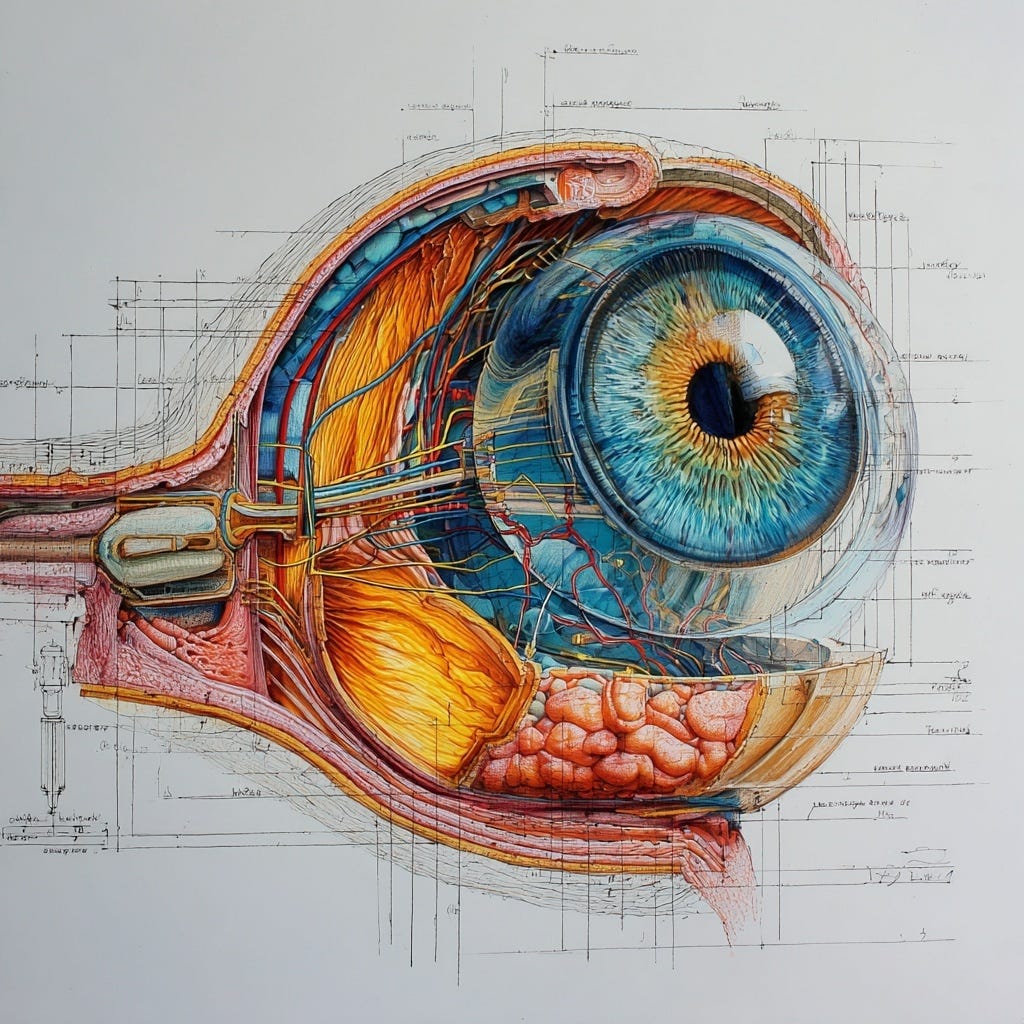
This was all very good. Vikid had learned much about the Eye, the brain, about Televisions, and about frequencies.
But ultimately all it said was that Red is the wiggling of an immaterial field. Or at best the wiggling of a bunch of cells. None of which could think or experience the color red.
It was as if you were saying that a golf ball understood the game of golf.
That was our best answer.
Which said absolutely nothing about Redness or the experience of the color Red.
Because Blue was the same thing, as was Green, as was a Guns n Rose song, as was the sipping of a cold Coca Cola.
It’s all wiggling fields and neurons!
It didn’t tell him anything of use on what the hell Red is…

He understood, explaining Red in terms of frequencies and signals was fairly easy, but figuring out what it actually was…
this really is a hard problem.
He didn’t feel that smart anymore.
And that’s,
The Vikid Truth
Notes
David Chalmers raised an important observation in the 1990’s.
Through scientific study, with careful observations and clever deductions we can conclusive explain biological functions and behaviours.
• “Easy” problems: Explaining functions and behaviors, such as perception, attention, memory, reportability, and how the brain integrates information to guide action. These are “easy” in the sense that standard cognitive science and neuroscience can, in principle, solve them by specifying mechanisms, algorithms, and neural circuits.
• The hard problem: Even if you fully specify all the neural mechanisms, computations, and behavioral dispositions, there is still an apparently open question: why do these processes feel like anything from the inside, instead of being performed “in the dark” with no experience at all?